
Problem Tree Analysis gives you a framework to map out the causes and effects of a problem, helping you visualize how various issues are connected that led to your current situation.
Before we discuss the problem tree in detail, let’s talk about a few problems.
All these problems share a common thread: treating symptoms instead of identifying root causes.
When such challenges occur, teams opt for quick fixes with traditional problem-solving approaches. During all this, the underlying issues, the real culprits, are left unaddressed.
To counteract, we have problem tree analysis, a solution that offers a structured analysis. Organizations can move beyond surface-level symptoms to tackle fundamental issues.
How?
By mapping problems visually and systematically identifying cause-and-effect relationships.
This guide helps you find out how this method transforms overwhelming challenges into manageable components by enabling your teams to focus their efforts where they’ll have the greatest impact.
This guide helps you find out how this method transforms overwhelming challenges into manageable components by enabling your teams to focus their efforts where they’ll have the greatest impact.
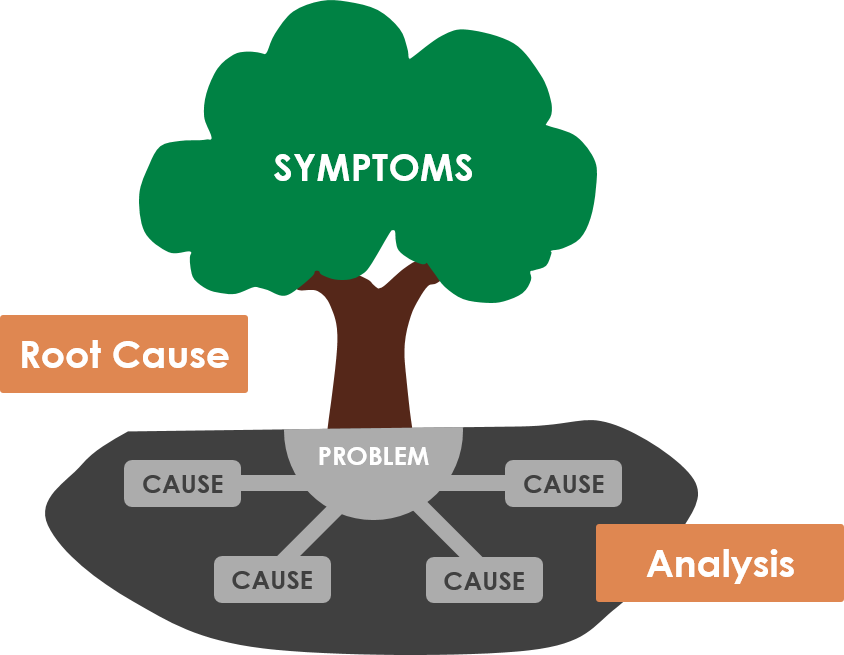
This structured problem-solving method visualizes problems as a tree diagram. The core issue lies at the center and its causes, like a tree’s branches spread across. It’s creating a visual map of how different factors contribute to the central problem, making complex issues easier to understand and solve.
So, what is the benefit, you might wonder? This analytical approach transforms abstract problems into concrete and actionable insights by breaking down big issues into manageable concepts.
Usually, teams are overwhelmed by seeing a massive problem. With a problem tree, teams can systematically identify what’s actually causing it.
Below is a typical example of a problem tree diagram.

A problem tree diagram follows a logical hierarchy, forming a visual structure. It immediately clarifies how different elements relate to each other and where to focus your problem-solving efforts.
The Trunk (Core Problem) | The main issue sits in the center. This is what you’re trying to solve. |
The Roots (Causes) | Causes branch out at different levels below the trunk. Direct causes connect immediately to the problem. Underlying causes feed into these direct causes. |
The Branches (Effects) | Above the trunk, you’ll find the consequences and impacts of the problem. |
This is the best tool if you have been facing:
The scope of problem tree analysis in project management can’t be neglected. Project managers use it as a diagnostic tool when projects face challenges such as underperformance.
Here’s how this diagnostic tool can be used in organizations to move beyond surface-level symptoms and address fundamental issues.
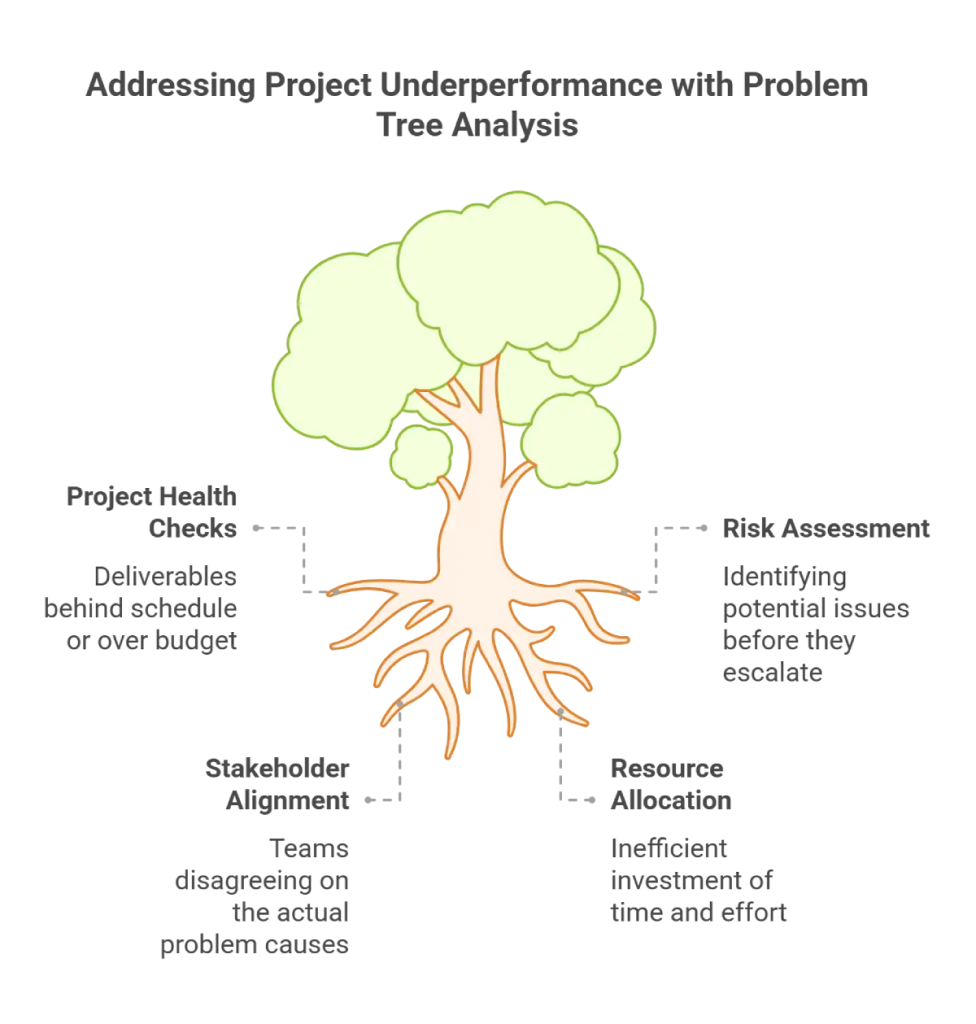
Management consulting firms significantly rely on issue tree problem-solving since it brings structure to an ambiguous business challenge. They believe this approach transforms vague concerns into clear, actionable plans.
Let’s see how they use this to identify problems:
Fishbone diagrams categorize causes by type, for example, process, people, and environment. Whereas problem trees show hierarchical relationships between causes.
The 5 Whys technique follows a single chain of causation. A problem tree, on the other hand, maps multiple interconnected causes simultaneously.
SOWT focuses on strategic positioning, while problem trees are all about specific operational issues.

So, now that you have got your hands on a practical, analytical tool, here’s the final takeaway for you:
Following the plan can help you experience the most successful problem tree analysis that leads directly to specific and actionable solutions, addressing the root causes.
We’d love to hear from you. Experiences, insights, and latest info on different topics are all welcome in our dedicated space for experts.
Let’s get in touch to spread awareness about Problem Tree Analysis.
It’s a visual technique that breaks down complex problems into smaller, manageable parts by drawing them like a tree structure. The main problem sits at the trunk, the root causes spread out below like roots, and the effects branch out above, just like branches.
Here’s what you should do:
This will help you visualize the problem with clarity.
