
Lean manufacturing, at its core, is built around two defining characteristics: the relentless elimination of waste and the continuous pursuit of improvement. These aren’t just buzzwords; they form the DNA of every high-performing, efficient operation on the planet. Whether you’re running a massive automotive plant or a precision tool shop, these two principles separate lean organizations from those constantly putting out fires.
Lean manufacturing isn’t about cutting corners; it’s about sharpening them. The aim is to create more value with fewer resources, ensuring every motion, material, and minute counts. In a global economy where efficiency equals survival, understanding and applying these characteristics is no longer optional; it’s existential.
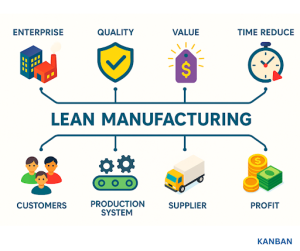
The Essence of Lean Thinking in Today’s Industry
The modern manufacturing world is brutal in its competition and breathtaking in its pace. Customers want faster delivery, zero defects, and sustainability, all at once. Lean thinking answers this challenge by focusing on value as perceived by the customer and ruthlessly eliminating everything that doesn’t contribute to it.
Lean isn’t a static playbook. It’s a living philosophy that constantly asks, “What can we improve today?” From Toyota’s original production system to today’s Industry 4.0 environments, lean’s core has stayed the same: value, flow, and continuous improvement. The two characteristics that drive this system, waste elimination and continuous improvement, are the twin engines of operational excellence.
Characteristic 1: The Elimination of Waste (Muda)
Understanding Waste Beyond the Obvious
In Lean terminology, “waste” (muda in Japanese) refers to any activity that consumes resources without creating value. That’s not just physical scrap or downtime; it’s everything from overproduction and waiting time to excess motion or poor communication. The key idea is simple: if the customer wouldn’t pay for it, it’s probably a waste.
Lean identifies seven types of waste: overproduction, waiting, transportation, overprocessing, inventory, motion, and defects. Many practitioners now add an eighth, underutilized talent, recognizing that ignoring human creativity is the most expensive waste of all.
Real-World Waste: Where It Hides
A typical example? Consider a CNC machining line where parts wait between stations for inspection. That idle time is invisible in many reports, yet it bleeds hours and costs. Or take an overstocked warehouse where inventory sits longer than it should, money literally gathering dust.
Eliminating such waste doesn’t mean slashing jobs or budgets. It means rethinking processes to let value flow seamlessly. For instance, a manufacturer that introduced one-piece flow instead of batch processing cut lead time by 60% and improved quality because operators could spot and fix problems immediately.
Tools that Power Waste Elimination
5S (Sort, Set in order, Shine, Standardize, Sustain) builds discipline and visibility.
Value Stream Mapping (VSM) exposes bottlenecks and non-value activities.
Kanban systems prevent overproduction by signaling demand in real-time.
Poka-Yoke (error-proofing) ensures mistakes can’t easily occur.
These are not just “lean tools”; they are mindsets turned into habits. The elimination of waste is the habit of asking every day: Is this activity creating value or just creating motion?
Characteristic 2: Continuous Improvement (Kaizen)
The Culture of Never Being “Done”
Continuous improvement, or Kaizen, is the second defining characteristic of Lean manufacturing. Where waste elimination is about cutting the unnecessary, Kaizen is about elevating the necessary. It’s the discipline of making small, steady changes that add up to massive transformation.
A Kaizen-driven company doesn’t wait for quarterly reviews or consultant reports to change course. Improvement becomes daily work. Operators, engineers, and managers alike are empowered to experiment, measure, and refine. In this culture, failure isn’t a red mark—it’s data.
The Human Side of Kaizen
Continuous improvement thrives only where people feel ownership. The best lean transformations start at the shop floor, where those closest to the process have the sharpest eyes for inefficiency. A Toyota engineer once said, “No one knows the work better than the one doing it.” That’s why Toyota has thousands of employee-led Kaizen suggestions implemented each year, tiny tweaks that collectively create monumental progress.
It’s not glamorous work. It’s daily grit, the kind that transforms “good enough” into “how could we do it better?” The idiom “slow and steady wins the race” fits Kaizen perfectly. It’s not about massive overhauls; it’s about small steps that never stop.
Frameworks and Techniques for Continuous Improvement
PDCA Cycle (Plan-Do-Check-Act): A scientific approach to problem-solving and learning.
Gemba Walks: Managers and engineers visit the actual workplace to observe reality, not reports.
Root Cause Analysis (Five Whys): A simple but profound questioning method that prevents surface-level fixes.
Standard Work: Documenting and improving the best current method, then repeating the cycle.
These practices ensure improvement is measurable, repeatable, and culturally embedded.
How These Two Characteristics Work Together
Elimination of waste and continuous improvement aren’t separate projects; they’re intertwined. You remove waste to create flow, and you improve continuously to keep waste from creeping back. The interplay between the two forms a self-reinforcing loop that strengthens operations over time.
Think of it like tuning a high-performance engine. Eliminating waste removes friction; continuous improvement keeps the engine optimized. Together, they drive performance that’s lean, agile, and resilient.
In an era of digital manufacturing, this synergy is even more potent. Data analytics, IoT sensors, and AI-driven quality control systems allow waste to be identified instantly, and improvement cycles to accelerate exponentially. But without the human mindset of lean, all that technology just automates inefficiency.
Lessons from the Toyota Production System (TPS)
Lean’s spiritual home is Toyota, where both these characteristics were born out of necessity. Post-war Japan faced resource scarcity, which forced Toyota to do more with less. Waste elimination and continuous improvement became survival tactics that evolved into world-class manufacturing principles.
At Toyota, every employee, from line worker to executive, is trained to spot waste and suggest improvements. They view problems not as failures but as opportunities to strengthen the system. This “problem-seeking” culture is why Toyota remains a benchmark decades later.
When Toyota introduced andon cords, ropes allowing any operator to stop the assembly line if an issue arose, it looked counterintuitive. Why halt production? But by fixing issues at the source instead of letting defects flow downstream, they reduced rework and downtime long-term. That’s Lean wisdom in action.
Lean in the Age of Industry 4.0
Where Technology Meets Philosophy
Industry 4.0, smart factories, automation, digital twins, and real-time data haven’t replaced Lean; they’ve amplified it. Waste elimination now includes data waste, and continuous improvement involves digital learning loops.
Imagine a plant using machine learning to predict maintenance needs before a breakdown occurs. That’s Lean waste elimination powered by technology. Or digital twins simulating process improvements before implementing them physically, that’s Kaizen at digital speed.
But caution is needed. Technology can’t substitute for Lean thinking. A poorly designed process running on an expensive AI system is still a bad process, just automated. Lean principles ensure technology serves value creation, not the other way around.
Building a Human-Centered Lean Future
Modern Lean manufacturing goes beyond efficiency; it’s about people. The best Lean organizations treat employees not as cogs but as contributors to collective intelligence. When people feel trusted to suggest improvements, morale and productivity rise hand in hand.
This human-centered approach also builds resilience. In uncertain times, supply chain disruptions, labor shortages, and energy volatility, Lean organizations adapt faster because improvement is ingrained, not imposed. That’s the hidden superpower of Lean: a culture that learns faster than circumstances change.
Why These Characteristics Still Matter
The world’s best manufacturers, from Toyota and Bosch to Boeing and Tesla, all apply these two characteristics differently, but the DNA is the same. Waste elimination builds efficiency; continuous improvement builds agility. Together, they future-proof operations against chaos.
In volatile markets, Lean thinking isn’t just a cost-cutting exercise. It’s strategic. It’s how you align business goals with real-world performance, balancing speed with quality and flexibility with stability. As automation and AI continue to evolve, the organizations that thrive will be those that combine human ingenuity with Lean discipline.
The Future Belongs to the Lean Thinkers
Lean manufacturing’s two defining characteristics, waste elimination and continuous improvement, aren’t relics of the past. They are the survival skills of the future. In an era where agility determines success, the smartest organizations will double down on these principles, not drift from them.
The companies that master Lean don’t just produce more efficiently, they think more clearly. They design processes that respect both people and profit. They turn every challenge into a lesson, and every inefficiency into an opportunity.
The question isn’t whether Lean still matters; it’s whether you can afford to operate without it.
Visit LeanManufacture.net to explore how your organization can turn Lean philosophy into measurable performance and build a smarter, more resilient manufacturing future.
